8/21/2017

THE SOURCE OF SCIENTIFIC KNOWLEDGE ( ILM AL_LADUN)


"We had taught him Knowledge from Our side (ilm al-ladun)."
—God (18:65)
"Now the discoveries of modern science are all Hidden Knowledge, that’s how you’re going to see it."
—Master Ahmet Kayhan (TPM p. 255.)

God-given Knowledge
The present article is an attempt to clarify the Master's saying in the epigraph. "Knowledge from Our side" (ilm al-ladun) is usually taken to mean secret knowledge. Master Kayhan, however, regarded all newly obtained knowledge—whether physical or spiritual—as (previously) hidden knowledge. Both were of value to him. The operative Verse here is: "Previously, you didn't know this" (12:3)—i.e., now you have been apprised of it. Hence, Sufic knowledge is more comprehensive than physical knowledge, which it includes and transcends.  
"Knowledge from God's side" means that knowledge—true knowledge—is imparted, granted, or "given," by God. God opens a window, as it were, granting access to the relevant part of His all-encompassing Knowledge/Science (ilm).
The act of scientific creativity is what drives science, and yet we still know little of its nature. One thing is certain: there is something revelatory about it. We sometimes tend to forget that the chemist Kekulé discovered the benzene ring, and physicist Niels Bohr his model of the atom, in dreams. (The first saw a snake swallowing its tail, the latter a planetary system.) In a letter to psychologist Carl G. Jung, physicist Wolfgang Pauli expressed his own experience with dreams: "Later, however, I came to recognize the objective nature of these dreams or fantasies."
“The discoveries of modern science are all
‘Hidden Knowledge/Knowledge from God's side’
(ilm al-ladun)”
Let us first look at some examples. For those not well-acquainted with science, these are all famous scientists.

Examples: "Eureka!" Moments
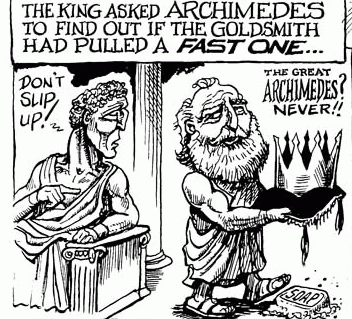
"Eureka," of course, refers to Archimedes, the scientist of Antiquity, who bolted from a bath-house naked upon discovering the principle of buoyancy.
Henri Poincaré (mathematics)
Poincaré has left us perhaps the most detailed account of how a mathematician's mind works. Here he is talking about his work on a certain class of mathematical functions:
"For fifteen days I strove to prove that there could not be any functions like those I have since called Fuchsian functions. I was then very ignorant; every day I seated myself at my work table, stayed an hour or two, tried a great number of combinations and reached no results. ...
Just at this time I left Caen, where I was then living, to go on a geologic excursion under the auspices of the school of mines. The changes of travel made me forget my mathematical work. Having reached Coutances, we entered an omnibus to go some place or other. At the moment when I put my foot on the step the idea [resolving the matter] came to me, without anything in my former thoughts seeming to have paved the way for it... I did not verify the idea; I should not have had time, as, upon taking my seat in the omnibus, I went on with a conversation already commenced, but I felt a perfect certainty. ...
Then I turned my attention to the study of some arithmetical questions apparently without much success and without a suspicion of any connection with my preceding researches. Disgusted with my failure, I went to spend a few days at the seaside, and thought of something else. One morning, walking on the bluff, the idea came to me, with just the same characteristics of brevity, suddenness and immediate certainty, that [resolved the issue].
Returned to Caen, I meditated on this result and deduced the consequences... Naturally I set myself to form all these functions. I made a systematic attack upon them and carried all the outworks, one after another. There was one, however, that still held out, whose fall would involve that of the whole place. But all my efforts only served at first the better to show me the difficulty, which indeed was something. All this work was perfectly conscious.
Thereupon I left for Mont-Valérien, where I was to go through my military service; so I was very differently occupied. One day, going along the street, the solution of the difficulty which had stopped me suddenly appeared to me. I did not try to go deep into it immediately, and only after my service did I again take up the question...
I shall limit myself to this single example; it is useless to multiply them...
Most striking at first is this appearance of sudden illumination, a manifest sign of long, unconscious prior work. The role of this unconscious work in mathematical invention appears to me incontestable, and traces of it would be found in other cases where it is less evident."

Jacques Hadamard (mathematics)
 Similar experiences have been reported by other mathematicians. One of them is Hadamard:
". . . One phenomenon is certain and I can vouch for its absolute certainty: the sudden and immediate appearance of a solution at the very moment of sudden awakening. On being very abruptly awakened by an external noise, a solution long searched for appeared to me at once without the slightest instant of reflection on my part—the fact was remarkable enough to have struck me unforgettably—and in a quite different direction from any of those which I had previously tried to follow."

Roger Penrose (mathematical physics)
Penrose had been working on what would become known as the event horizons of black holes.
"A colleague... had been visiting from the USA and he was engaging me in voluble conversation on a quite different topic as we walked down the street approaching my office in Birkbeck College in London. The conversation stopped momentarily as we crossed a side road, and resumed again at the other side. Evidently, during those few moments, an idea occurred to me, but then the ensuing conversation blotted it from my mind!
Later in the day, after my colleague had left, I returned to my office. I remember having an odd feeling of elation that I could not account for. I began going through in my mind all the various things that had happened to me during the day, in an attempt to find what it was that had caused this elation. After eliminating numerous inadequate possibilities, I finally brought to mind the thought that I had had while crossing the street—a thought which had momentarily elated me by providing the solution to the problem that had been milling around at the back of my head!"

Andre Marie Ampére (physics)

The unit of electric current is named after Ampére. Here are the circumstances of his first mathematical discovery:

"I gave a shout of joy ... It was seven years ago I proposed to myself a problem which I have not been able to solve directly, but for which I had found by chance a solution, and knew that it was correct, without being able to prove it. The matter often returned to my mind and I had sought twenty times unsuccessfully for this solution. For some days I had carried the idea about with me continually. At last, I do not know how, I found it, together with a large number of curious and new considerations concerning the theory of probability."

Andrew Wiles (mathematics)

Grappling with a solution to Fermat's Last Theorem, Wiles came upon a flaw in his efforts:

A year later, at the point of defeat, he had a revelation.—"It was the most important moment in my working life. Nothing I ever do again will be the same." The very flaw was the key to a strategy he had abandoned years before. In an instant Fermat was proved; a life's ambition achieved; the greatest puzzle of maths was no more.

Karl Friedrich Gauss (mathematics)

Gauss described how he finally proved a theorem on which he had worked unsuccessfully for four years:

"At last two days ago I succeeded, not by dint of painful effort but so to speak by the grace of God. Like a sudden flash of lightning, the enigma was solved. For my part I am unable to name the nature of the thread which connected what I previously knew with that which made my success possible."


Examples: Revelatory Dreams
Niels Bohr (physics)Bohr worked on many different designs trying to figure out what the structure of an atom was, without much success. Finally, one evening he went to sleep. In his dream, he saw the nucleus of the atom, with the electrons spinning around it, just like our solar system with the sun and planets. When he woke up, he knew what his answer was. Using this model, Bohr developed the so-called "old" quantum mechanics, for which he was awarded the Nobel Prize in physics. He spoke often about how it was the dream that gave him the answer he had been searching for.


Albert Einstein (physics)

As a young man, Einstein had the following dream:

"I was sledding with my friends at night. I started to slide down the hill but my sled started going faster and faster. I was going so fast that I realized I was approaching the speed of light. I looked up at that point and I saw the stars. They were being refracted into colors I had never seen before. I was filled with a sense of awe. I understood in some way that I was looking at the most important meaning in my life ... my entire scientific career has been a meditation on my dream."
He awoke, soon formulating the constancy of the speed of light and thus, his famous theory of relativity.


Otto Loewi (biology)
Loewi was working on how nerves transmit impulses. Then one night he fell asleep and had a vivid dream. He dreamed of an experiment that would prove once and for all that transmission of nerve impulses was chemical—not electrical, leading to his discovery of the neurotransmitter acetylcholine.

"The night before Easter Sunday of that year I awoke, turned on the light, and jotted down a few notes on a tiny slip of paper. Then I fell asleep again. It occurred to me at 6 o'clock in the morning that during the night I had written down something most important, but I was unable to decipher the scrawl.

The next night, at 3 o'clock, the idea returned. It was the design of an experiment to determine whether or not the hypothesis of chemical transmission that I had uttered 17 years ago was correct. I got up immediately, went to the laboratory, and performed a single experiment on a frog's heart according to the nocturnal design."

He won the Nobel Prize in medicine for it.


Dmitri Mendeleyev (chemistry)
Mendeleyev was trying to make sense of how the chemical elements are organized. One day, he fell asleep while chamber music was being played in the next room. He understood in a dream that the elements were all related to each other in a manner similar to the themes and phrases in music. When he awakened, he was able to write out for the first time the entire periodic table, which formed the basis of modern chemistry.


Srinivasa Ramanujan (mathematics)
Ramanujan used to say that a local version of a Hindu deity whispered equations in his ears, or showed him scrolls in his dreams. For instance:

"While asleep I had an unusual experience. There was a red screen ... I was observing it. Suddenly a hand began to write on the screen. I became all attention. That hand wrote a number of results in elliptic integrals. They stuck to my mind. As soon as I woke up, I committed them to writing..."

Friedrich August von Kekulé (chemistry)

One afternoon, Kekulé fell asleep and dreamt what gave him the clue to a discovery which has been called "the most brilliant piece of prediction to be found in the whole range of organic chemistry"—that the molecules of certain important organic compounds are not linear structures, but closed chains or rings.
"I turned my chair to the fire and dozed. Again the atoms were gambolling before my eyes. This time the smaller groups kept modestly in the background. My mental eye, rendered more acute by repeated visions of this kind, could now distinguish larger structures, of manifold conformation; long rows, sometimes more closely fitted together; all twining and twisting in snakelike motion.
But look! What was that? One of the snakes had seized hold of its own tail, and the form whirled mockingly before my eyes. As if by a flash of lightning I awoke ... Let us learn to dream, gentlemen."

The Stages of Scientific Creativity
Despite persistent research into its nature, the roots of scientific creativity continue to elude inquiring minds. One well-known model maps it as a fourfold process: preparation, incubation, illumination, and verification. (The above examples have focused primarily on the illumination stage.)
What is interesting is that these stages for the physical sciences have their exact counterparts in the spiritual (religious) sciences. These are stages in attaining spiritual maturity, or spiritual perfection.
Preparation, the initial stage, is a period of intense concentration on the problem at hand. This period may last days, months, or even years. This is the period of sowing: "There is nothing for a human being except what s/he has labored for" (53:39). Or, as the Bible puts it, "if a man does not work, neither shall he eat" (2 Thess. 3:10).
The most productive work for scientific creativity is achieved in seclusion and solitude. There is more than a tinge of religious asceticism in the toils of great minds tackling scientific problems. For instance, Andrew Wiles, the mathematician who solved Fermat's Last Theorem, secluded himself in his attic and worked on the problem for almost seven years in near-total secrecy. He shut out everything but Fermat, and confided only in his wife. And then, he had to work another year to correct a flaw in his proof.
In the spiritual sciences, this stage corresponds to active prayer. This is not just a matter of "Lord, give me this and give me that," but conscious labor or "struggle" (mujahada)—more precisely, struggle against the Base Self, opposition to its demands and caprices, doing the opposite of what the Base Self wants. It is also a struggle to wake up. According to Prophetic Sayings: "Human beings are asleep, they wake up when they die," and hence: "Die before you die," so that you may experience spiritual rebirth while still in this world. This too may take years, or even more, for it is no easy matter.
Incubation, the second stage, is where the problem is set aside for a while. All the efforts of rational thought having failed to seize the fortress, as it were, the conscious mind turns to other matters and occupies itself with unrelated things.
This would correspond to detachment in the spiritual sciences: to dissociate oneself from one's efforts, to attain a state of quiet receptivity, of alert relaxation—to abandon the Base Self. As the Sufic saying goes: "You get out from in between, and the Creator at once is seen"—"You" being the Base Self (and its subsequent stages, until the final level is reached).
Illumination occurs when the solution suddenly bubbles up from the unconscious, either fully formed, or in a way that easily leads to success. It can happen either while awake or in a dream. This is the critical stage, yet it would not be possible without the stages that came before it.
What is really interesting about this stage is that it occurs quite without warning, and the scientist involved is at a loss to describe exactly how it was arrived at. "I don't know how I got it" is a frequent exclamation. Apparently, the arts have no monopoly on inspiration: it applies to the sciences as well.
The French mathematician Jacques Hadamard was interested in the psychology of mathematics, and especially in mathematical creativity. He described the experiences of the mathematicians Carl Friedrich Gauss, Henri Poincaré, theoretical physicist Hermann von Helmholtz, and other mathematicians and physicists, as viewing entire solutions with "sudden spontaneousness" (p. 15). In The Emperor's New Mind (1989), mathematical physicist Roger Penrose cites some of Hadamard's cases and adds his own (pp. 541-550). To use his expression, the solutions came to them "in a flash" ("Like a sudden flash of lightning"—Gauss).
In the spiritual sciences, too, this is called illumination—or enlightenment, or "observation" (mushahada). Without struggle, there is no possibility for observation. In the case of prophets, this may be called "revelation" (wahy). For others, it may be called "unveiling" (kashf), where the scales fall from one's eyes and one observes Reality in its full splendor for the first time. (One should, however, guard against premature unveiling—before the ultimate level of selfhood is reached—because it is counterproductive.)
In both kinds of sciences, this is the stage of reception. One is clearly on the receiving end of things: receiving physical or spiritual knowledge from The Source.
Verification, finally, is the stage of consolidation, "rationalization," confirmation by experiment and derivation, where the details and formal proof are worked out painstakingly and systematically. This is basically a stage of convincing one's peers, of making the discovery acceptable to the wider scientific community. By the end of this stage, little may remain that points to the original blinding insight. And yet, without that revelatory moment, no progress would have been possible at all.
And in the spiritual sciences, this is the stage of proclaiming the truth to others, inviting to faith, and also of measuring everything against the yardsticks of the Koran and the Prophetic Way. This is not blind faith, but a faith whose truth has been verified, and can be perceived by all who have eyes to see—just as the truth of a scientific matter in the physical world can be assessed and approved only by scientists competent to pass judgment in that field, and the rest of us have to take them at their word.

Conclusion
Perhaps this sudden illumination is not divine revelation, as that is the province of prophets. But it is certainly inspiration of the purest sort. It is this inspiration that is the original source of knowledge (in both the physical and the spiritual sciences). Working out a laborious proof to "balance the books," to make everything neat and tidy and scientifically respectable, comes later.
As Jacques Barzun commented on Hadamard's study, "it is clear in the end that in any process of creation there lurks a mystery—a mystery at least equal to that of thinking itself." The recipients receive knowledge, but they do not know how they receive it. It comes to them ready-made.
Blaise Pascal was candid enough to state that many of his mathematical insights came directly from God. It is in this context that the full implication of the Master's explanation becomes clear: both spiritual knowledge and physical knowledge are "given," "inspired" ("in-spirited," communicated to the spirit) by God, via His Attribute of Knowledge (ilm).
This also shows that we do not live in a "clockwork universe." God did not create a watch, wind it up, and leave it alone for the rest of eternity. Rather, He actively intervenes in the universe all the time: He is at a task each instant (cf. 55:29). He provides inspiration for all persons—scientists, artists, and mystics—when the appropriate time arrives, and in accordance with their labor. God is beyond the universe, but also within: He is both transcendent and immanent. Moreover, because God is the true Source of scientific knowledge, knowledge/science is the common property of all humanity. So is art, and so is spirituality.


A Note on Sources
The examples of Poincaré, Hadamard, Gauss, Ampére, and Kekulé are taken from Arthur Koestler, The Act of Creation (1964), pp. 115-18. Penrose is taken from Roger Penrose, The Emperor's New Mind (1989), pp. 543-4. Bohr, Einstein, Loewi and Mendeleyev are from Jesse Hong Xiong, The Outline of Parapsychology (2010), pp. 279-80. Wiles is from the BBC. Use was also made of the worlddreambank.org collection (Einstein, Loewi). Ramanujan can be traced back to T. K. Rajagopalan, who is quoted in S. R. Ranganathan, Ramanujan : The Man and the Mathematician (1967), p. 87.

1/30/2017

SUFI COURTESY (ADAB)


“Never condemn sinners until you’ve learned for sure whether I have forgiven you.”
—God in a Holy Tradition
(Bursevi,  Ruh-ul Beyan, 9/806.)

“No father can give his child anything better than good manners.”
—The Prophet (Tirmidhi)
Sufi courtesy (adab) is the opposite of uncouth behavior. It is praiseworthy, admirable and even sublime conduct. Martin Buber is famous for advancing the concept of an “I-Thou,” as opposed to an “I-it,” relationship. In Sufi courtesy, you treat everything in the universe as a “Thou.” You could not, would not, even kick a can or a stone. You would treat the lowliest ant as a being worthy of respect.
For instance, the famous Sufi Abu Yazid of Bistam went on pilgrimage to Mecca. On his way back, he bought some safflower seeds in Hamedan. When he arrived at his hometown Bistam, he discovered that he had brought some ants along with the seeds. He felt that he had no right to dislocate the ants in this way. Hence, he went all the way back to Hamedan and released the ants there. (pp. 86-7.) In an age when the fastest mode of travel was on horseback, the distance between the two towns was (and is) some 725 km/450 miles!
This may be too extreme for us. But surely we can at least give our seat to an elderly person on the bus?
The Prophet of God said:
“None of you will have authentic faith until your hearts are made right;
nor will your hearts be made right until your tongues are made right;
nor will your tongues be made right until your actions are made right.”
This quotation tells us that spiritual growth must proceed from the outward toward the inward. Until our actions have been corrected, inner change is quite impossible, or at least impermanent. As the Ottoman poet Ziya Pasha wrote,
The mirror of a person is his works, to words pay no heed
The level of one’s intellect is reflected in one’s deeds.
The root meaning of adab (plural âdâb) comes from ma’duba, invitation to a banquet (of knowledge, or rather wisdom). The Ottomans called men of letters “the courteous” (adîb) and literature “matters of courtesy” (adabiyat), because literature was devoted to inspiring courteous behavior in members of society. For the follower of adab, life itself is a work of art (as both Peter Brown and Ira Lapidus have noted).

One of the best definitions of Sufi courtesy has been provided by the famous Sufi Ibn al-Arabi:
“He who has courtesy has achieved perfect refinement of words and deeds by weighing himself in the Scale of the Law. … S/he always puts things in their proper places, says the proper thing at the proper time, and acts according to the requisites of divine wisdom. It is s/he alone among all human beings who ‘gives each thing its due’.”
Adab is courtesy, respect, appropriateness. Adab is not formality. Adab helps to create the context in which we develop our humanness. Every situation and relationship has its  proper adab, i.e., between friends, in relation to family members, in relation to the Teaching, in relation to one’s Teacher. Adab also means ‘beautiful action’, i.e., the form of behavior that creates the conditions in which the attributes of God may be clearly reflected.

(Here, based on Adab: The Courtesy of the Path.)
The Tradition of the Prophet, “Adorn yourselves with the ethics of God,” thus actually refers to courteous conduct. Indeed, the Prophet also said: “My Lord taught me courtesy and perfected it within me.” Thus the Prophet is the exemplar for perfect ethics, for perfect courtesy (refined ethics).

The general meanings of adab are: politeness, courtesy, good manners, refined manners, good breeding, respect, reverence, correct behavior,  proper conduct, modest behavior, being courteous; discipline, correction, chastisement; the science of polite learning, culture of mind. According to Abu Al Najib Al Suhrawardi: “Nobody can properly enter the Way of the Sufis until knowing its fundamental beliefs, its rules of conduct (âdâb) and its technical terms.”  

The Creation of Adam
The purpose of religion is to earn God’s pleasure, and that can happen only by virtue of noble conduct. Right from the very beginning, human beings have not been able to do without courtesy. After God had created Adam, Master Ahmet Kayhan related,
God said to Gabriel, ‘Let’s give him something.’ He sent three
presents: Mind, Faith, Courtesy. He said, ‘Whichever one he chooses,
bring back the other two.’

Adam thought. He has no mind, no ideas, he’s a mudcake. Again this

isn’t Adam’s work, it’s God’s. There’s a Giver. He said, ‘I’ll take Mind.’
Gabriel said, ‘You chose the best.’ He said to Faith and Courtesy:
‘Come on, let’s go.’ Faith said: ‘Without me, Mind can’t manage.’ He
turned to Courtesy, ‘Let’s go.’ Courtesy said, ‘I’m the garment of these
two. Without me, neither of them can manage by themselves. I stay,
too.’ So they all remained with Adam.

Gabriel conferred with God. ‘What shall I do?’ God said,
‘Everything’s found its proper place, if he can use them. The trust has
found its place. Come back.’
(H. Bayman, The Teachings of a Perfect Master (2012), pp. 269.)

Features

Here are some features of courtesy:
- To make our practices more and more inwardly sincere, rather than outwardly apparent.

- To recognize our own faults, rather than finding faults with others.

- To recognize our own ego and struggle against its manifestation by remembering that our greatest ally is Love.

- To limit our preoccupation, worry, vanity and ambition over the world and the worldly.

- To seek to heal any wrong we may have caused to another, and to correct any misunderstanding as soon as possible.

- To remember that no good will come out of the expression of anger or excessive hilarity.

- To be patient with difficulties.

- To recognize and remember that we all are members of the same [human] family.

- To avoid gossip and bad-mouthing.

- To be indifferent to favor or benefit for oneself, for “receiving one’s due.”

- To be free of [jealousy] and ambition, including the desires to lead or instruct others.

- To do what one does as service to the Tradition – not for the desire for reward or the fear of punishment.

- To accept with gratitude suggestions and criticism from one’s Teacher. 

(Here.)

Don’t Embarrass People

In matters of courtesy as in other things, the role model for Sufis is the Prophet. He had a very refined sensibility and was always careful never to shame people.

Sometimes, the sublimity of a response is in direct proportion to the grossness of the act that elicits it.
The Qurayshites around the Prophet drank alcohol. He said, ‘Don’t
speak ill of them because they drink.’ He regarded the drunkard with
mercy.

There was a bedouin Arab tribe chieftain. That tribe had faith, they
had recited the Word of Witnessing. He said, ‘Let me go and see the
Messenger of God.’

He came, he asked, they said, ‘He’s in the Mosque.’ He went over

and introduced himself: ‘I’m from such-and-such a tribe. I’ve come to
see you.’ He said, ‘Sit down.’

There are lots of townspeople and strangers in the Mosque, he’s
listening to their troubles, he’s making inquiries. The man began to
fidget, he had to obey the call of nature. He said ‘Excuse me,’ the
Prophet said ‘Okay,’ but he didn’t say what his problem was. He went
to a corner of the room and relieved himself. They’re tribespeople,
they don’t know any better.

The Companions are upset, the Prophet of God looks, the smell
spreads all over the place, he signals them: ‘Don’t say a word,’ he says.
That man comes and takes his earlier place.

The Prophet cuts it short, ‘Come on,’ he says, ‘let’s talk outside.’
Without giving that man the slightest hint.

They get up, they step outside, he says: ‘Give me a dustpan, a broom
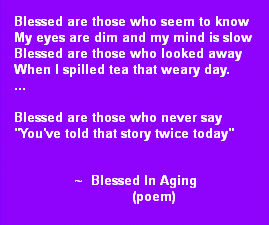
and some water.’ ‘Messenger of God, let’s …’ ‘This is my guest. He
came for me.’ They insist, he says ‘No. You go out, too.’

He takes the excrement, throws it outside, digs the ground, covers it,
smooths it over, then comes over to them. The Companions are again
amazed.

They talk outside, he sees him off, gives him some money, ‘Goodbye.’

Three years later he comes again. The same man. They were sitting
in the Mosque again, he greets them. He sits down in propriety and
courtesy. Religion, good manners have spread everywhere.

He kneels, after inquiring how he is: ‘Messenger of God, with your
permission I’d like to kiss your hand.’ ‘Why, what for?’ ‘I came to you
once, and did such an unseemly act. Please forgive my error.’ ‘No, no,
no. Good for you, good for you.’
(H. Bayman, The Teachings of a Perfect Master (2012), pp. 306-7.)

Making Courtesy a Part of Your Life
Courtesy is manifested to the highest degree in the prophets and their successors, the saints (though not every Book extant today recognizes this). Prophets and saints are human beings, but spiritually they’re giants.

The Sufi concept of courtesy offers a refinement not easily available anywhere else. Note that in Arabic, khulq (plural akhlaq) means both character trait(s) and moral conduct. Thus, these terms can be used interchangeably. This means that traits such as kindness to all creatures, respect, compassion, avoiding gossip, and lovingkindness, need to be internalized until they become part of one’s innate character, one’s equipment. Otherwise, they will remain unassimilated and will be lost in the face of the first adversity.
This is the really hard part. Anyone can play-act or pretend. But can you do it when you’re choking? That’s the real test!
As the Prophet remarked, “The most perfect believer is the one with the best manners. And the best among you are those who are best to their wives.” (Tirmidhi 628; Riyad as-Salihin, 1.278.) He also said: “Nothing weighs more on the scales on Judgment Day than sublime conduct.” “Thanks to his noble character, a believer will attain the degree of one who Prays during the night and fasts during the day.” (Tirmidhi 2002 – Abu Dawood 2233.)
This last is very important. The Prophet is saying that beautiful behavior—that is, moral conduct that inspires admiration in others—is as important as worship, and will even substitute for it.

Access to God
“but . . . can’t you tell me something good about Islam?"

Abdullah thought for a while. “In the end,” he said, “the best thing

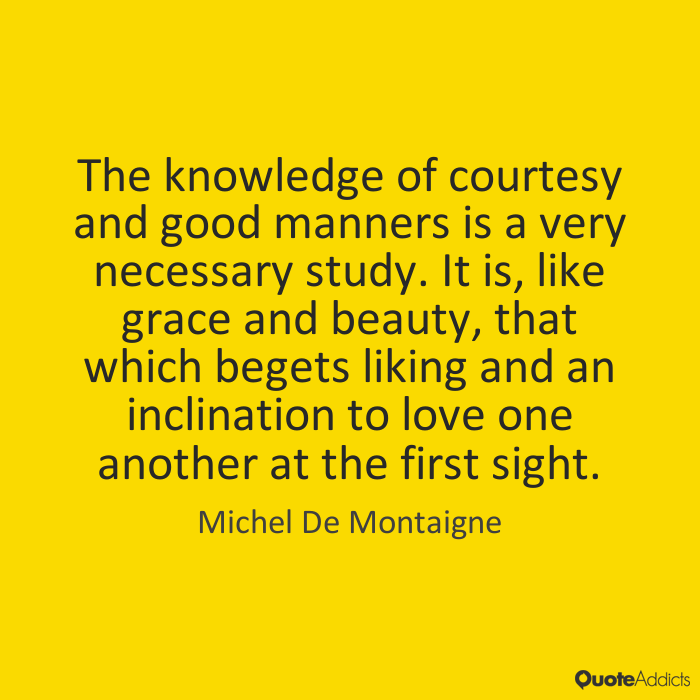
about Islam is that it gives you access to God. Perhaps other religions do too,
but Islam does it better than any other I know. That’s the point of all these
rules—if you follow them, you can go places you couldn’t otherwise go. Ac-
cess to God is something that’s hard for many people to understand. Per-
haps you’ve felt something like it sometimes, perhaps while contemplating
nature. It’s a feeling that Freud called “the oceanic,” though he understood
it rather differently. [Psychologist Abraham Maslow’s “peak experiences” and “self-actualization.”] Before I became Muslim, I once felt it sitting by the
edge of a lake during a beautiful sunset. Anyhow, that’s the point about Is-
lam: instead of happening by chance once or twice in a lifetime, that can
happen all the time.”

One can see something of this access to God—or to the oceanic—in
the faces of many Muslims in the Muslim world—in what the British poet
Kathleen Raine called “faces of radiant beauty and the joy of life.” In cities
like Cairo, despite the poverty and the disorder, it is sometimes possible
to glimpse something magically beautiful. The tawdry and ugly and com-
monplace is transformed into the special, the glowing. That, in the end,
may be the real point about Islam.

—Mark Sedgwick, Islam & Muslims (2006), p. 228.
Hatim “the Deaf” and the Flatulent Woman

A woman came to the sage Hatim one day to ask him a question. At that moment she broke wind, she wasn’t able to help it. Her face changed color.

Hatim said to her, “Speak louder. I’m hard of hearing.”

This he said in order that the woman would not be put to shame. She raised her voice, and he answered her problem.

As long as that woman was alive, for almost fifteen years, Hatim pretended he was deaf, so that no one would tell the woman that he was not. After her death he gave his answers readily. Until then, he would say to everyone who spoke to him, “Speak louder.” That was why he was called al-Asamm (“the Deaf”). His secret was outed one day when it became clear that he was able to hear the buzz of a mosquito that no one else could. His hearing was better than anyone else’s!

The Sinners and the Saint

The story is told of a group of men who decided to test whether a certain person was a saint or not. Accordingly, they engaged a prostitute and a debaucher for their plan. The man, going his way, beheld the couple committing lewd acts in the middle of the street.

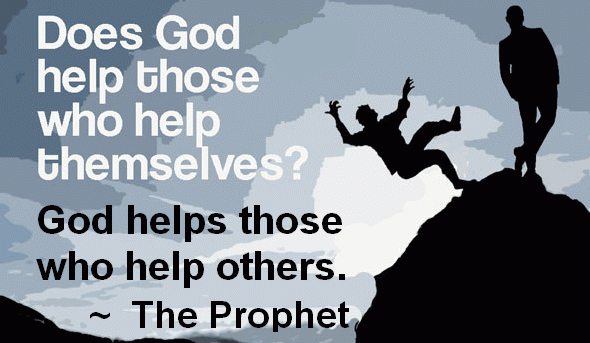
He immediately found a large straw mat from close by and, without saying anything, covered them with it. This was in accordance with the principles: “Cover what you see, don’t tell what you haven’t seen,” and “In hiding the shames of others, be like the night.” For the same reason, it has been said: “The hearts of sages are the graves of secrets.” These in turn are based on the Tradition: “Whoever alleviates the need of a needy person, God will alleviate his needs in this world and the Hereafter. Whoever conceals the faults of a servant (of God), God will conceal his faults in this world and the Hereafter. God helps those who help their brethren, as long as they help them.” (Muslim (4/2074) No. 2699, etc.)
This also brings to mind the famous Sufi, Jalaluddin Rumi. As I related recently, Rumi once came upon some prostitutes, who showed him great respect. He told them: “You ladies are champions! If you didn’t bear these burdens and hardships, who would subdue so much lust and so many carnal souls (Base Selves)? And how would the chastity and purity of chaste and pure women ever be known?”

Self-Sacrifice

Hospitality is one of the hallmarks of courtesy. A man came to the Prophet one day and said: “I’m starving.” The Prophet told those in his company: “Whoever hosts this man tonight, God will have mercy on him.” One Companion (Abu Talha) accepted. But when he went home, his wife told him they didn’t have anything to eat, there was only enough supper to feed the children.

He said to her: “Put the children to bed early. When our guest begins to eat, reach out as if to adjust the lamp, but put it out instead.” She did as she was told. In the semi-darkness, the husband and wife pretended to be eating, going through the motions, but they let their guest eat whatever food there was. They themselves went to bed hungry.

When they visited the Prophet the next day, he smiled and said: “God marveled at your conduct toward your guest last night.” A Koranic verse was revealed in their honor: “they prefer others above themselves, even though they themselves are in need. Those who overcome their stinginess—they are the successful ones” (59:9). (Bukhari 5.58.142.)
(Note: Many Traditions suffer from bad translation into English, to the extent that their actual meaning is obscured.)

Compassion

Compassion, too, is a part of courtesy. There is a Tradition to the effect: “God does not show compassion to those who do not show compassion.” The opposite of this is also true.
Driving through a storm one night, a man saw a kitten drenched to the bone by the roadside. After driving a bit further, he turned the car around over the objections of his wife and rescued the kitten from its plight.
That night he had a dream: he saw the Prophet of God, who patted him on the cheek affectionately. And shortly afterwards, he was graced with a visit to Master Ahmet Kayhan, becoming one of his students.

Don’t Break a Heart
In this respect, it has been said:  “Break a Heart, you demolish the Kaaba. Mend a Heart, you build up the Kaaba.”
Don’t you hurt or offend a living being
You’ll burn up [God’s] Highest Heaven.
And again:
If you want to be esteemed among human [and other sentient] beings,
Neither hurt/offend anyone, nor be hurt/offended by them.
Even if you are offended, you should not offend.


Courtesy Toward the Enemy

Once the battle is over, a wounded enemy soldier is no longer the enemy, but a human being in need. Master Kayhan again:
After a battle outside Medina, the Prophet asked: ‘Two persons, one is a Muslim, the other is an infidel or a Christian. They both ask for water. Who do you give it to?’
‘We give it to our brother,’ they say. Omar asks: ‘What do you say, Prophet of God?’ ‘First to the enemy, if he’s dying. If possible, divide in two and give half to your brother first.’
(TPM, p. 306.)
 This is the hardest thing to accomplish: to treat someone who intends to kill you as if enmity between you didn’t exist at all. As I have written earlier:
This would be the point to remember the performance of Ali during the Battle of the Ditch. When he was fighting an opponent, as he was about to deal the final blow, the man spat in his face. Ali withdrew, lowered his sword, and said: “Stand up. We must repeat the fight.”
The man was shocked: “Ali, what’s going on?”
“At first, I was fighting you for the sake of religion. But as soon as you spat in my face, my Base Self rose up and interfered. If I killed you under those circumstances, I would have been doing it for the sake of my own ego and not for religion. Therefore, we must fight again.”

Try to See the Good Side of Everything
Walking down an alley one day, Jesus and his disciples came across the rotting corpse of a dead dog. The stench was so terrible that it left the disciples retching and gagging.
Jesus, however, knelt down and gazed at the dog for a long moment. Then he said: “Praise be to God, what beautiful teeth it has!” (Attar, Musibatnâma; Nizami, Khamsa.) (The same story is also told of the Prophet Mohammed. The important thing is the message, which is the deed itself.)

Don’t Get Embroiled in Arguments
An argument is a clash of egos, a battle between (Base) selves. Therefore, it is better to shun disputes altogether.
Once, while the Prophet was sitting with his Companions, someone used insulting words against Abu Bakr, causing him pain. But Abu Bakr remained silent. The person again defamed Abu Bakr, but Abu Bakr still did not respond. When this ignorant person offended Abu Bakr a third time, Abu Bakr gave him the reply he deserved.
At this point, however, the Prophet stood up to leave.
Abu Bakr asked anxiously, “Are you displeased with me, Prophet of God?”
The Prophet replied, “No, but as long as you remained silent, an angel had come down from heaven and was negating the man’s claims. The moment you started answering him, that angel departed and was replaced by a devil. And I can’t remain where the devil is present.” (Abu Dawood 041 4878.)
This is also why the Prophet said: “Whoever leaves an argument when s/he is in the wrong, a residence is built for them on the outskirts of Paradise. Whoever gives up an argument despite being right, a residence is built for them at the center of Paradise. Whoever beautifies his moral conduct, a residence is built for them on the highest reaches of Paradise.” (Ibn Majah 1.51.)


Courtesy Toward God
Just as there is courtesy toward God’s creatures, there should also be courtesy toward God. For consider:
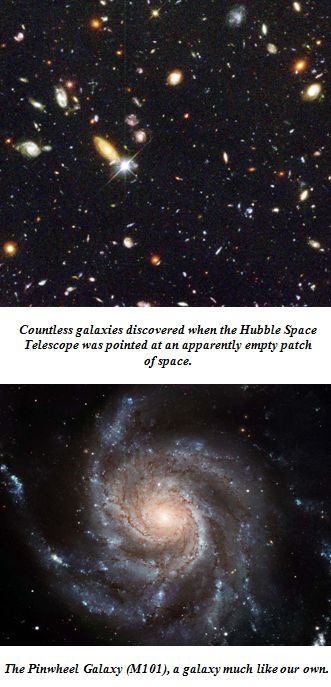
- There are some 100 billion galaxies in the observable universe (thats billion, not million),

- There are an estimated 100 billion stars in each galaxy,
- The sun, an average star, is about 1,300,000 times the size of the Earth,
- The Earth weighs about 6 sextillion (billion trillion) tons.
Thus, a galaxy is but a speck of dust with respect to the universe, a star is just a speck of dust with respect to a galaxy, the Earth is a speck of dust with respect to our star the sun, and we are much, much less than specks of dust with respect to the Earth.
Now God is the Creator of this entire universe. It thus becomes much easier to understand Sacred Verses like: “Do not walk arrogantly on the face of earth, for God does not love conceited and arrogant persons” (31:18). For the same reason, the Prophet said: “Those dearest and nearest to me on Judgment Day are those with the best manners. And those most hateful and distant to me are blabbermouths and the arrogant.” (Tirmidhi 631.)
On the other hand, humility is a virtue that God values highly. One should be humble not just toward God. True humility entails respect and, ultimately, love for all God’s creatures.
What should courtesy toward God be like? For one thing, it should be marked by steadfastness, by true constancy.
In the time of Moses, one of his people spent all his time worshiping God in seclusion. One day, God told Moses: “I have decreed that that servant of mine is among those who have strayed from the Path. This is so whether he worships Me or not. Go and tell him.” So Moses told the man. He replied: “I seek only to please God. If that is what He wants, what can I say? I don't know about such matters. Let Him put me in hell if He wants, as long as He is pleased with me.” So saying, he gave thanks to God.
Whereupon God transfers that man from among the Strayers to the Worthies. And He again tells Moses to inform him. In reply, the man says: “Well, I don't know about that either. I only wish to please Him. God knows best, as long as He is pleased with me. Whether He puts me in heaven or hell is His affair. I don't know such things.”
This is a good example of courtesy toward God. To be resigned to whatever God has in store for us is a mark of true servanthood.
In the Koran we find the Verses: “Contented Soul, return to your Lord, Pleased (with Him) and Pleasing (to Him)” (89:27–8). In Sufism, these refer to stages in the seven levels of selfhood: the Contented Self is Stage 4, the Pleased Self is Stage 5, and the God-Pleasing Self is Stage 6 (the penultimate stage). Now God has said: “I am pleased with My servants, as long as they’re pleased with Me.” (TPM, p. 50.)  This is a herald of good news: once the traveler reaches Stage 4, things become much easier, and God’s pleasure with us follows as soon as we’re pleased with Him.
The real hurdle, then, is for us to be pleased with God. And for this, we need to give much thanks to God, for He has also said: “I will increase the (causes for) thanks of whomever gives thanks to Me.”

Luqman’s Last Lesson

Luqman was a saint and a doctor who lived sometime between Jesus and Mohammed. He is famous for his saying: “I learned courtesy from the discourteous. I did the opposite of what I saw them do.”
Perfect surrender. To swallow poison as if it were honey.

That reminds me of Luqman. His teacher loved Luqman very much.
He came first among a hundred and fifty, two hundred students. He
admired his morality, his courtesy, his work.

In February or March, a student brought his teacher a melon, hard

to find in that season. But the melon had been punctured, and when a
melon is punctured, it becomes bitter like poison. The second day, the
teacher says to his servant, ‘Go and call Luqman.’ He wants him to eat
the melon because of his love for him. Luqman comes, kisses his hand,
they chat.

The teacher says, ‘Wash that melon and bring it over.’ They wash
and bring it to him, he gives it to Luqman with his own hands. Luqman
takes a bite, his mouth is filled with poison, but without the slightest
sign of discomfiture on his face, he eats it all. Finally, only one slice is
left.

His teacher says, ‘You ate with great zest. It’s stimulated my appetite.
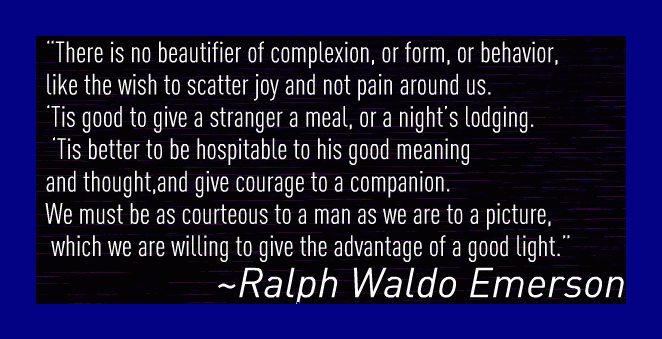
Let me eat this slice.’ ‘Of course,’ he says, ‘eat it.’ He puts it in his
mouth, bites and … throws up. Because he’s old, he passes out. Luqman
brings a towel right away, he wipes his mouth and chest. He brings
water, does a few things and revives him.

The teacher sits up, tears come from his eyes. ‘Why, I was killing
you because I loved you. How on earth did you eat that?’ Yes! ‘How
did you eat it with smiling face and such appetite?’

He again kisses his hand, ‘Teacher,’ he says, ‘I would give this life for
you. This is coming from your hand,’ he says, ‘no matter what it might
be.’

‘I almost killed you with my own hand. Do you want something,
something sweet?’ ‘No,’ he says, ‘I’m fine, I’m young, don’t worry.’

The next day, at school, the teacher fills out Luqman’s diploma.

‘Two lions can’t remain in one place,’ he says, ‘your studies with me are
concluded. Farewell.’ And he becomes Luqman.

These are very difficult. Very difficult to believe. To do the bitter
part. The other side is light, but to make honey out of bitterness. To be
human, to become Luqman.
(TPM, p. 291.)

The Scholars and the Sages

Civility reaches its summit in courtesy or sublime conduct (adab). Humility, harmony, and altruism are all aspects of courtesy, as exemplified in the following story.
A certain ruler was one day made aware of the existence of the People of Wisdom. The sultan had not heard of them before. He asked his vizier, who was highly intelligent and his guide in all matters, “What is the difference between a man of knowledge and a man of wisdom, a scholar and a Sufi, a scientist and a sage?”

“Your highness,” said the vizier, “this is best explained by watching the respective groups in action.” So they first went to a symposium of scholars and scientists—dressed up incognito, of course. They stationed themselves at the entrance. “Observe, your highness,” said the vizier.

As the worthies, each an intellectual giant in his own right, began to come in, the vizier asked the first one: “Who is the greatest among you?” “I am, of course,” came the reply. “Me, naturally,” said the second. The same question was asked, and the same reply received, from all participants in the symposium.

“Now, your highness,” said the vizier, “let us go to a Sufi convention.” Similar scene, different people, and the vizier addressed the same question to the first entrant.
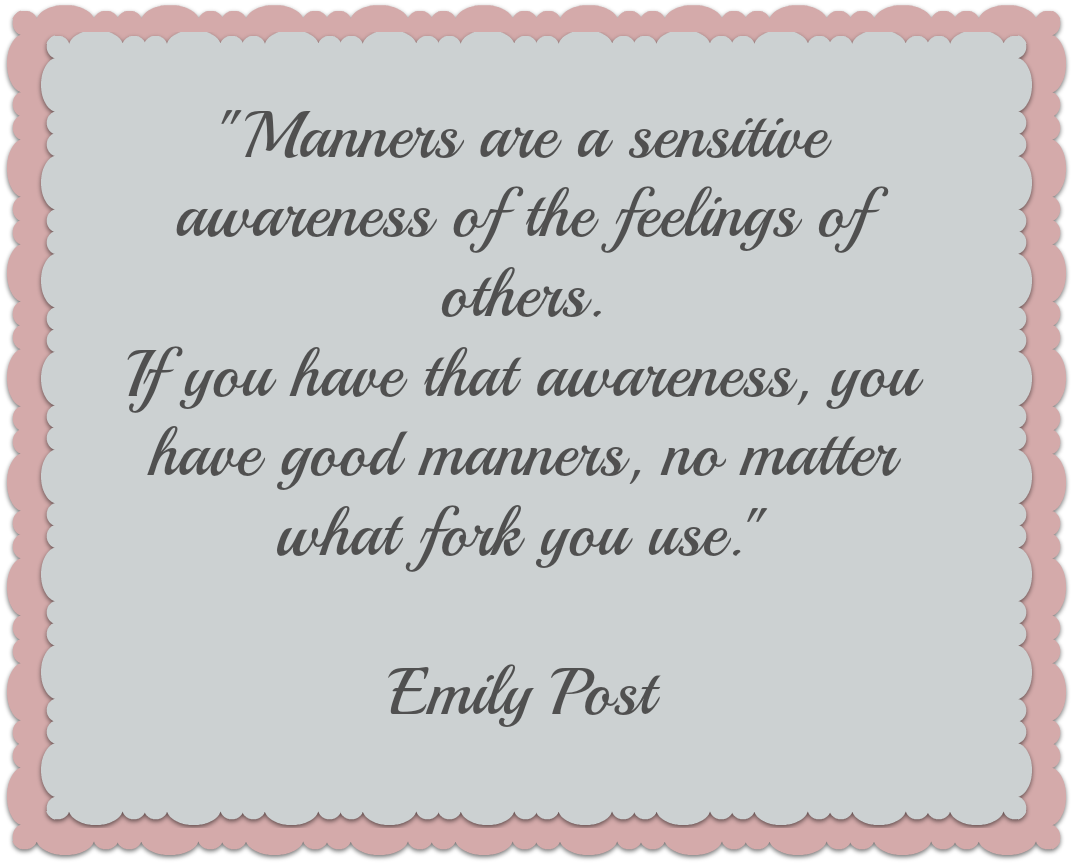
“Behind me,” he answered, and hurried in. The second sage gave the same reply. So did the third, and the fourth . . . until the last one, who said, “They all went in before me.”

“Let us come back in the evening, when they’re all about to disperse,” said the vizier. Now both the symposium and the convention were occurring in buildings close to each other, and there was a river flowing in front of both—a shallow river with stones in it.The vizier gave instructions so that other roads would be blocked, and both the scientists and the sages would be forced to cross the river.

“Watch,” he told the sultan.

The men of knowledge were the first to leave. Seeing that there was nowhere else to go, they all tackled the river, each in his own haphazard way. They shouldered each other, there was rough play, pandemonium reigned. Shouts were heard, some stumbled and wet their garments, while others even fell into the river.

The vizier smiled. “Let’s hurry over to the convention,” he said to the sultan.

They arrived just in time to see the first sage emerge. Immediately taking in the situation, he said to the fellow behind him: “Follow in my exact footsteps,” and proceeded across the river, using the rocks as stepping stones. And so did all the rest, carefully using only the stones stepped on by their predecessor. They were across the river in no time; not even their shoes were wet.

“For our encore, your majesty,” said the vizier, “we shall have to make special arrangements. And we shall have to invite your subjects to dinner.” He gave orders for special spoons to be made.

A few days later, both groups received invitations from the palace to have supper. It was arranged so that one group would arrive earlier the same evening, the other later.

The scientists arrived first and were ushered into the dining room.

What they saw was this: a round table, in the center a pot of soup, and spoons set up around the table—spoons with a handle at least a yard long.

Doubtful as to how to proceed, they took their seats around the table. But when they tried to eat, they found it to be impossible. The spoons were too long to be held conveniently, and if they tried to hold one at a shorter length, its tip would intrude into the eye of a neighbor. There was a great commotion as the soup was spilled all over the table, to the accompaniment of shouts: “Watch out!” “Ouch!” and “I’ll show you!” Finally they went away, hungry, malcontent, and grumbling at each other.

Next it was the sages’ turn. They arrived, sat themselves around the table, took up the spoons—and began to feed each other, each person dipping a spoon into the soup and then offering it to the person directly across the table. The spoons, it turned out, were made exactly the right length for just this approach. They all supped in quiet merriment, thanked the sultan and the vizier, and departed in decorum.

“That,” observed the vizier to the sultan, “is the difference between a man of mere knowledge and a man who is truly wise, the difference between a scholar and a sage.”
(H. Bayman, The Station of No Station (2001), pp. 182-4.)
Needless to say, if everybody behaved with excellent conduct, all our social problems would be solved. All the utopias of those who long for a better world would be fulfilled.

Ah, Courtesy
(The following sayings regarding “courtesy,” or splendid moral conduct, have been culled from the Traditions of the Prophet and the aphorisms of the great saints. It was a sheet often distributed by the Master.)

What is courtesy?

“Courtesy is to act in accordance with the Prophet’s Way.”

“Courtesy is to train the self as necessary and to decorate it with beautiful morals.”

“Courtesy is to possess the knowledge and principles that protect one from all error.”

“True courtesy is to renounce the lower (Base) self.”

“The beginning of all courtesy is to speak little.”

“The least of the rules of courtesy is for one to stop when one senses one’s ignorance and to remedy it.”

“Courtesy is: not to overvalue one’s superiors, and not to belittle one’s inferiors.”

“Courtesy is to be in control of one’s hand, one’s tongue, and one’s loins [sexuality].”

Facts and statements related to courtesy:

“The difference that sets humans apart from the animals is courtesy.”

“A mind unadorned with courtesy is a hero without a weapon.”

“Without courtesy, nobility is naught.”

“Courtesy is a weapon that kills the devil.”

“Courtesy is the beginning of everything. The whole of Sufism is courtesy.”

“Courtesy is the first requirement of perfection.”
“One who abandons courtesy is not wise.”

“Fortify courtesy, renounce all else.”

“Who lacks courtesy has no trustworthy knowledge.”

“Truth is nothing but courtesy.”

“Cloak your shame with courtesy.”

“True beauty is beauty of knowledge, and courtesy.”

“The adornment of a human being is that person’s courtesy in its entirety.”

“An orphan is not one whose parents have died, but one who lacks knowledge and courtesy.”

“Those who fail to teach courtesy to their children will please their enemies.”

“The intelligent person learns courtesy from the discourteous.”

“With the honor of knowledge and courtesy, Adam was raised above the angels.”

“Satan was banished from God’s presence because he abandoned courtesy.”

“The discussion [of sages] is a body. The spirit of that body is courtesy.”

“In order to attain Truth, one needs Knowledge of Certainty; for Knowledge of Certainty, one needs sincere deeds; for sincere deeds, one needs to perform the Obligations of God; for this, one needs to follow the Way of the Prophet; and in order to do that, one needs to observe courtesy.”

“One who has not been trained by the Sufis cannot understand the truth of courtesy.”

“Everything loses value as it increases. But when courtesy increases, it becomes more valuable.”

“One who does not adopt the courtesy of one’s Master cannot adopt the courtesy of the Prophet’s Way and Traditions. And one who does not adopt these cannot adopt the courtesy of the Koran and its sacred verses.”

“There is no honor higher than courtesy.”

“One who would learn wisdom should act courteously.”

“One who seeks to possess good deeds should seek to learn knowledge courteously.”

“As long as the People of Love possess goodwill in the matter of love, their courtesy will increase.”

“Courtesy is the absolute source of virtue for a human being.”

“The friends of courtesy are: Modesty, Sincerity, Submission, Love, Intention, Obedience, Striving, Discussion, and Service.”


What is earned by courtesy?

“Courtesy makes a person sincerely loved.”

“Courtesy is the power that protects a person from shameful things.”

“Discourteous acts interrupt enlightenment, and drive their owner from the heart of the King.”

“Those who serve their Master courteously earn stations as high as the Throne.”

“Those who enter their Master’s presence with courtesy will earn boundless enlightenment.”

“Spiritual elevation is only possible with courtesy.”

“The stations of Paradise are earned by good works and courtesy.”

“Those who lack courtesy are driven from God’s doorstep.”

“Courtesy is the greatest art. It is food for the road that leads to God.”

“Courtesy is the guide and sign of the Friends of God. It is the cause of communion with God.”


I sought admission to the Assembly of Knowledge;
Knowledge was left behind—courtesy, just courtesy.

It covers the shames of humanity;
What beautiful clothing is the garment of courtesy.

I sought admission to the People of the Heart;
Every aptitude has value, but first place goes to courtesy.

Courtesy is a crown made of the light of God;
Wear that crown, and be safe from all calamity.


(Based on H. Bayman, The Secret Of Islam (2003), Appendix A, pp. 309-12.)