12/20/2013

Superman and Sufism

YOUR CHOICE
Click below to listen to Superman theme music


 sm01
All that I have, all that I’ve learned, everything I feel… all this, and more I… I bequeath you, my son. You will carry me inside you… all the days of your life. You will make my strength your own. You will see my life through your eyes, as your life will be seen through mine. The son becomes the father, and the father becomes the son.

—Jor-El to Superman in Superman 1 (1978);
Superman to his son in Superman Returns (2006)

My servant keeps coming closer to Me through optional [additional] worship. In the end he attains My Love. And when I love him I become the ears that he hears with; I become the eyes he sees with, I become the hands that he holds with, I become the feet that he walks with… When he seeks refuge in Me, I safeguard him.
God in a Holy Tradition
(Bukhari, 8.76.509)


This essay is about the Superman of comic books and motion pictures. My study of philosopher Nietzsche’s Superman can be found in The Station of No Station: Open Secrets of the Sufis (2001) and in the last chapter of Weaver Santaniello (ed.), Nietzsche and the Gods (2001). It is also available on the Internet.
 sm02
Being superhuman is not gender-specific. It applies to boys and girls (or guys and gals) alike.

Superman

Superman is the archetypal superhero, the model for all other superheroes. Why does he attract so much attention, above and beyond all the others? Because the saga of Superman tells us something very profound about ourselves. Yet we can’t quite put our finger on it, for the allusions are veiled.

We mostly think of Superman’s defining characteristic as having superpowers. My long association with Sufis taught me, in the end, that a Superman is an ethically superior human being. S/he is committed to superior moral behavior, even in the face of adversity. Of course, the Superman of comics and movies also has superior ethics. But we never stop to consider that, perhaps, his superpowers are the result of those ethics.
 sm03
Laying oneself down to save others: Superman bridging a gap in the rails to prevent a train from falling into a precipice.
For nonordinary powers to manifest themselves, one’s self has to be purified of all inferior conduct. After all, there has to be certainty that those powers will not be abused or misused. According to the Sufis, when a sufficient level of self-purification is achieved, a metamorphosis occurs. Darkness is transmuted into light. This is no conjecture, but established fact.

This is a spiritual transformation, not a physical one. I was going to give the example of “lead being transmuted into gold,” were it not for the danger that this may be misunderstood as physically changing lead into gold.

In real life, then, the extraordinary powers of Superman would not be due to Earth’s yellow sun, but to moral perfection. And yet, one must not fixate on obtaining these powers in and for themselves. They are merely the side-effects of a much more profound transmutation. So much so, that Sufis are actually ashamed when paranormal abilities are attributed to them.

Lex Luthor

sm04

Luthor is Superman’s principal adversary. He is the personification of evil. From a superficial viewpoint, Luthor represents Satan, the external principle of evil, as opposed to Superman’s symbolism of good. So do all the other monsters and villains Superman fights. From a deeper, Sufic level of interpretation, Superman symbolizes Spirit, while Luthor stands for the internal principle which is complementary to Satan, the Base Self that always incites to evil (Koran, 12:53). This is our inner demon that we are seldom aware of. Because of this, we are all the more vulnerable to its attacks. As the Buddha said in his first sermon: “You suffer from yourselves. None else compels…” So many souls could with remorse say: “So many things I would have done, but the Base Self got in my way.”

Sometimes, the struggle against the Base Self is depicted in a more obvious fashion. For instance, red kryptonite, which has unpredictable effects on Superman, causes him to split into two, a good side and an evil side, who then fight each other, as in Superman 3 (1983). A similar situation can be observed in Spiderman 3 (2007):

sm05


Other examples are the talks with one’s mirror image, as in Spiderman 1 (2002) or the TV series Falling Skies (S03E04, 28:00-30:00, 2013). In these, the mirror image represents the Base Self, which subsequently “possesses” the being of the person:

sm06


It would seem this all goes back to The Picture of Dorian Gray (1890) by Oscar Wilde, where Dorian’s misdeeds directly disfigure his portrait. That portrait reflects the true face of his Base Self.

This brings to mind what Jonah said while in the belly of the whale (or more properly “fish,” since this is how both the Bible and the Koran state it): “I have been of the wrong-doers (zalimeen)” (21:87). But what kind of wrong-doing is this? We find the answer in 4:97 and 16:28, where the expression is “sinned against their souls” or “wronged themselves” (zalimee anfusihim). But what does this, in turn, mean? Both “oppression” and “darkness” derive from the Arabic root ZLM. So we arrive at “darkened their selves.” In the belly of the whale, dark, damp and constricted, Jonah realizes: “I have darkened (blackened or defiled) my self.”

In conclusion, then, Dorian was “darkening” his self (mutilating his own portrait). Every time he willfully committed a sin, his self sank deeper into a morass of darkness. The opposite of this would be purifying one’s self, about which the Koran says: “God loves those who purify themselves” (9:108) and “Success belongs to one who purifies one’s self” (91:9).

As the Spiderman 3 poster aptly points out, “the greatest battle lies within.” This is an almost exact paraphrase of the Prophet’s saying: “The greatest battle is the struggle against the (Base) Self.”

Kryptonite

sm07
Kryptonite is the one thing that can harm Superman. It can even kill him. The least it can do is rob him of his powers. In the hands of a Luthor, it can be a lethal weapon. In the same way, there are two tools in the hands of the Base Self that it can use to destroy a human being. One is Illicit Gain, the other is Illicit Sex. So from a Sufic perspective, kryptonite symbolizes the Unclean (or sinful: haram). (In the Ten Commandments, these are summarized as “Thou shalt not steal” and “Thou shalt not covet your neighbor’s wife,” respectively.) The antidote for the first is a job, where you earn your livelihood by the sweat of your brow. The antidote for the second is a legally wedded wife for a man, or husband for a woman (marriage is between opposite sexes). To paraphrase George Bernard Shaw, marriage combines the maximum of opportunity with the minimum of interference.

God says in the Koran: “Do not approach fornication” (17:32). Notice that He does not say “do not engage in” or “do not commit.” Why not? Because this is such a slippery slope that you find yourself at the bottom before you know it.

Those who indulge in Unclean Sex (and/or Gain), I was told, cannot learn the secrets of the universe. It’s that simple.

What of those who, not knowing this, have already sullied their selves, their hands and/or their private parts? For them, the road of repentance lies wide open. God says in a Holy Tradition: “My mercy exceeds My wrath.” To repent with a contrite heart, to start afresh with a clean slate—God is All-forgiving, All-merciful, provided you refrain from erring again.

Kryptonian language

sm08
In the TV series Smallville, part of the second season (S02E17 and S02E22) was devoted to Kryptonese. Especially the sequence 5:34-6:32 in S02E17 (“Rosetta”) is interesting in this respect. When Clark fits an octagonal key in the cave wall, the whole sequence of letters, arranged in concentric circles, begins rotating, finally shooting out a beam that “teaches” Clark how to read Kryptonian.

The sequence can be found below, at 3:24-4:22 (comments have been muted).


To the untrained eye and mind, the Arabic of the Koran might as well be written in Kryptonese. The Koran seems incomprehensible to us in its original Arabic, and even in translation it is a difficult read. And yet, just as Kryptonian is supposed to encode knowledge far superior to ours, the Koran must somehow embody hidden knowledge, since it is revelation from God. Of special interest are the “isolated letters” that precede each chapter, the meanings of which remain a mystery to this day—though not for lack of speculation. I’m reminded of that episode sequence whenever I think of them.
Even when you have read the Koran, do not suppose you have understood it. The example given above about “darkening one’s self” is a good illustration of this. We need a skeleton key to make sense of it all. That key is Sufism. The Koran itself states: “It is He who has sent down to you the Book. In it are clear/precise verses that are the Essence of the Book, and others ambiguous/allegorical … None understands them save God, and those firmly rooted in knowledge” (3:7). Those well-grounded in knowledge are the greatest among the Sufis. Although there are other ways of reading it as well, a Sufic perspective unlocks the secrets of the Koran.

Unfortunately, one can easily lose the delicate balance necessary for this, just as it is easy to go overboard in all things. This is why the Divine Law is necessary at all times.  The Divine Law keeps one steadily anchored in ethics, and prevents one from straying into dangerous waters. (The Divine Law comprises the injunctions of the Koran plus the Sayings of the Prophet.)

Fortress of Solitude
 sm09

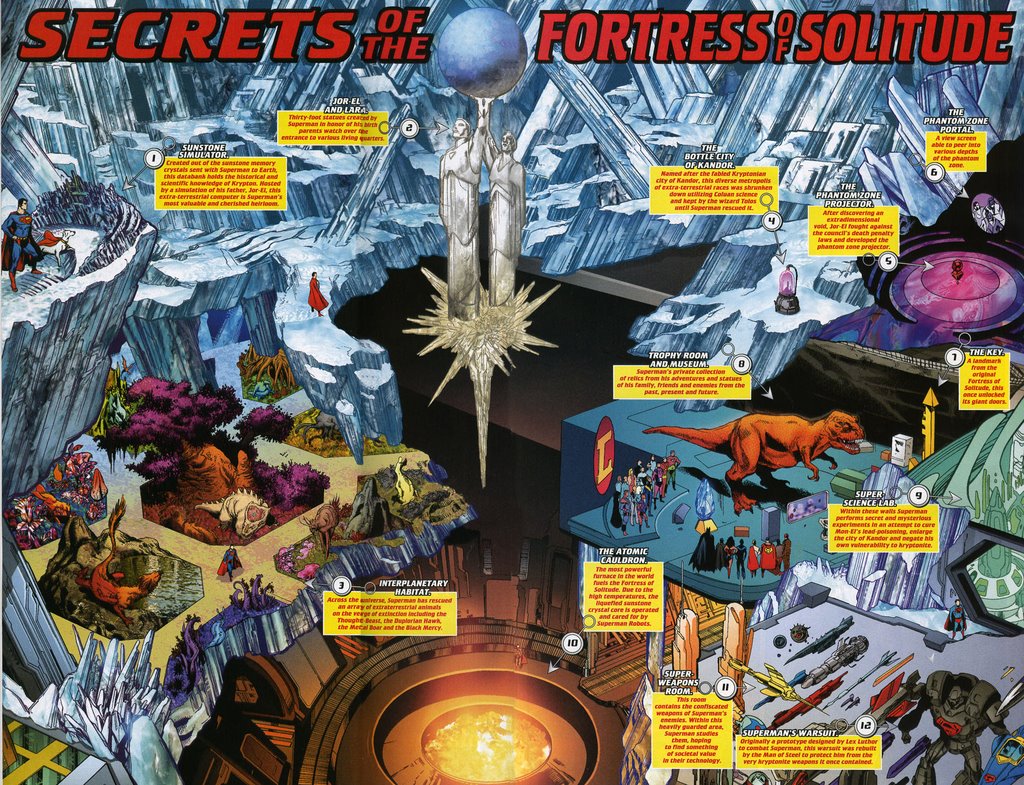
Similar to a hermit’s cave or meditation retreat, Superman’s private sanctuary at the North Pole is called the Fortress of Solitude. He goes there to take time off from his heavy duties of protecting the Earth and humanity. It also contains equipment connecting him with his legacy, and a museum where artifacts from his past adventures are displayed.

Throughout history, people who have desired solitude have taken refuge in caves in order to meditate and/or approach God. This is often accompanied by fasting and other forms of worship. Moses spent forty days on Mount Sinai (twice). Jesus spent forty days fasting in the desert, from which is derived the period of Lent. In Islam, the Prophet retreated to a cave near Mecca for a long period before receiving God’s revelation. (Besides the Prophet himself, Noah, Abraham, Moses and Jesus are considered the greatest prophets in the Koran. They are called “steadfast,” endowed with constancy (46:35).) The corresponding period of fasting in Islam is a period of thirty days during the month of Ramadan. The forty-day retreat of the Sufis (called arba’in, “forty”) exactly parallels the times for Moses and Jesus.

It has often been remarked about Sufis that they are “in the world but not of it.” When one is outwardly with people but inwardly with God, and cannot be shaken from this state by the vicissitudes of life, one no longer needs to retreat to a cave. In fact, spiritual progress achieved in the seclusion of a cave may sometimes be inferior to that achieved in the thick of life. This is illustrated by a Sufi story:

Several hundred years ago in Anatolia, on Hasan Mountain, there lived a lone mystic called Hasan Baba (Baba means “Father”). There he devoted himself to prayer and meditation. He lived off the milk of deers, which let him milk them. After some years of living in a cave, Hasan decided to visit his old friend, Stoker Ali Baba. (Ali worked at a Turkish bath, and “stoker” is the person who tends the fire that heats water in a public bath.)
As a gift for Ali, Hasan Baba milked a deer, collecting the milk in his handkerchief. Because of his spiritual power (baraka), the milk did not run through the cloth. He tied it up at its corners, and went down to the town where Stoker Ali lived.
Arriving at the public bath, Hasan Baba hung the kerchief on a nail outside and waited for Stoker Ali to come out. Now it was the women’s hour at the bath, and ladies who had just finished bathing were leaving. Hasan caught sight of a few ankles.
Milk began dripping from the bottom of the kerchief.
Stoker Ali, who was coming out just then, noticed this. “Hasan Baba,” he said wrily, “your milk is dripping!”
Then he took out a flat case from his breast pocket. He opened it and showed it to Hasan Baba. Inside were a red-hot ember on one side and gunpowder on the other, separated only by a wedge of cotton.
If the ember were to ignite the cotton, he would be blown to bits.
“If my attention were to waver for even an instant,” said Stoker Ali Baba, “that would be the end of me. As you can see, I’m still alive after all these years!”

This version of the story may be exaggerated, but you get the idea. Achievements in seclusion may be weak compared to those in the bustling, blooming, busy world.

Flight

sm10

Let me begin by relating an anecdote of a friend of mine. Back in 1999, when the movie The Matrix hit theaters, he watched it at a movie theater in Turkey. Seated behind him were a couple of Turkish youths. At the end of the movie, the hero, Neo (Keanu Reeves) is seen flying off at great speed. When the lights came back on, there was a moment of stunned silence (the film even spawned an underground cult). Then one youth said to the other, “I guess it’s time we started performing the Prayer (namaz).”

Of course, Neo was the Matrix version of Superman, and one of Superman’s outstanding abilities is flight. Now flight has to do, above all else, with vertical elevation. And as discussed in the companion article, “Superheroes and Sufism,” this immediately brings to mind the Ascension (miraj) of the Prophet. Moreover, every human being who does the Prayer is enabled to participate in that Ascension, because the Prophet proclaimed: “Prayer is the Ascension of the faithful.” The difference is that this elevation takes place in the spiritual realm, not the physical, and it is rarely perceived consciously. But the subconscious knows. In fact, if it were possible to make the subconscious conscious, we would perceive this elevation in the waking state. Both the postures and recited prayers aid in this exaltation during Prayer. So the youth overheard by my friend was more right than he himself could have realized.

In the 10-year Smallville TV series, flight is the last superpower that Clark gains (series Finale, S10E22). Likewise, it is to be hoped that the long struggles of a Sufi will be crowned by a conscious Ascension.

A symbolicdepiction of an Ascension is given below:


 (The masks symbolize the Attributes/Names, the fiery globe symbolizes the Essence.
Self-Purification

If one works on the Base Self long enough, it passes through various stages (outlined elsewhere on this site), finally achieving the Purified Self. The Koran says: “God wishes to purify you completely,” “to lead you out of darkness into light” (33:33, 33:43).

When that happens, one casts off human attributes like a snake sheds its skin, and becomes clothed in divine attributes. In a metamorphosis from caterpillar to butterfly, the Clark Kent gives way to the Superman. Yet the external appearance remains that of a Clark Kent, for this transmutation occurs spiritually, not physically.

The Purified Self is free of all selfishness and egotism. It always looks out for the greater good. This, and this alone, is the level of selfhood that can be entrusted with nonordinary knowledge and nonordinary power. The person who has achieved this stage can be given the keys to the Kingdom, and it is the duty of that person to protect the world and human beings. Truly a job for a Superman!

sm11

*      *      *

sm12

Superheroes and Sufism


I'm trying my hand at something new today. As always, I rush in where angels fear to tread, so I hope my readers will forgive me for this latest misadventure!
Introduction
Consider Jules Verne, who may properly be called the father of modern science fiction. In 20,000 Leagues Under the Sea, published in 1870, Monsieur Verne conceived of an underwater vessel driven by a power that was “almost infinite.” He called it “the Nautilus.” In 1954, the United States Navy commissioned the first nuclear submarine. It was called the “USS Nautilus.” This was, of course, in honor of Verne’s initial conception.
shnautilus

Now consider the case of the Titanic, which sank in 1912. The disaster was foretold in not one, but four novels published prior to the shipwreck:
The most striking and prophetic example is The Sinking of a Modern Liner, written in 1886 by English journalist W.T. Stead.
The story is eerily similar to the actual Titanic‘s ill-fated demise. In Stead’s book, an ocean liner leaves Liverpool and while on a journey to New York City, becomes involved in a collision. In the ensuing panic, many passengers drown because there are too few lifeboats.
In a strange twist of fate, Stead inadvertently foretold his own death in the book: he was onboard the Titanic when it sank in April 1912.
How about the next one? That was Futility: The Wreck of the Titan (1898).
Name: In Futility, the boat is described as the largest ship of its day and was called the Titan.
Size: The ships were practically the same size, with the Titanic measuring only 25 meters longer.
Date: Both ships, described as “unsinkable,” hit an iceberg and went under in mid-April.
Speed: Both were capable of speeds over 20 knots.
Safety: Despite having thousands of passengers on board, both ships carried the bare legal minimum number of lifeboats.
Sinking Location: Titan is also deemed “unsinkable” but hits an iceberg and sinks off the coast of Newfoundland, just like the Titanic.
shtitanic
  Here we have predictions that foretold the event decades before it actually occurred. It is obvious that we are here dealing with a situation of a different order than Jules Verne’s Nautilus. As a visionary, Verne might have been able to imagine many of the developments to be achieved by scientific progress in future times. But what the two other novels demonstrate is a phenomenon that we may properly term paranormal, and which fall under the class of precognition.
Paranormal events suggest that there are phenomena that do not easily fit into our present worldview. Actually, many of us have had the experience of intuiting the occurence of a distant event as it occurs, or even before it happens. This is a faculty granted by God to all human beings, including atheists, just like our liver or our mind. But because it is a neglected faculty, we perceive its operation only intermittently or sporadically. An entire apple tree is hidden in a tiny apple seed. But it will blossom and bear fruit only if you plant and cultivate it.
A case in point is telepathy. As defined by Wikipedia, telepathy “is the transmission of information from one person to another without using any of our known sensory channels or physical interaction.” (For this, see also “quantum teleportation” below.) After years of study, the philosopher H. H. Price observed: “We must conclude, I think, that there is no room for telepathy in a Materialistic universe. Telepathy is something which ought not to happen at all, if the Materialistic theory were true. But it does happen. So there must be something seriously wrong with the Materialistic theory, however numerous and imposing the normal facts which support it may be.” In that case, we must be open to possibilities beyond those that “are dreamt of in our philosophy.”
The facts about the Titanic mentioned above seem to make sense, and to be possible, only if we make the following conjecture: there exists a mental space whereby we are able to access the future, even if only rarely.

Comic Books and the Imagination
sh01 
As a child, I used to read comic books—lots of comic books. Then I grew up, went on to other things, and made some discoveries that are not ordinarily granted to many. I have been very lucky indeed, even graced, in this respect. Readers familiar with my writing already know that I attempt to present Sufism in novel and radically different ways. Well, when I look back on my childhood and my experience with comics, I realize that certain concepts I later encountered in Sufism were already heralded in… stories of superheroes!
How can this be? How can deeply esoteric concepts emerge from the minds of comics and science-fiction writers? The answer lies in the IMAGINAL WORLD—not the imaginary world, but the Imaginal World (alam al-mithal).
Contrary to first impressions, the Imaginal World is real, though not physical. Just as the world of numbers, of mathematics, is not physically real: you don’t encounter the number 3 as an object in the physical world, except perhaps on children’s blocks, and yet it is very real. Some mathematicians even believe that the world of mathematical objects exists independently of our human existence. They conceive of an “intelligible world,” which we are able to access mentally. This is called mathematical platonism. According to the Stanford Encyclopedia of Philosophy, it “is the metaphysical view that there are abstract mathematical objects whose existence is independent of us and our language, thought, and practices.” In the cases of the Nautilus and the Titanic, we had a passage from-concrete-to-concrete. Here, we have a bridge from-concrete-to-abstract. So we are able to reach a further conclusion: that mental space we conjectured probably has an abstraction level.
shLyapunovfractals
 
Lyapunov fractals. Do mathematical entities exist in a world independently of ours?

Like the World of Mathematics, things of the Imaginal World are very real, even if they do not have a physical existence. It was Henry Corbin (who also coined the Latin term Mundus Imaginalis for the alam al-mithal of the Sufis) who best described it: in this world, abstract ideas have forms. They have extensity. And because of this, they occupy a world in-between mind and matter. Hence, this region resolves the mind-matter dichotomy of Descartes!
 shmilk
Example: in the Imaginal World, milk represents Knowledge.
Now we have become accustomed to thinking of the imagination (khayal) as dealing with unreal things. We associate it with illusion. And yet, this is not entirely accurate. The imagination does, of course, deal with unreal things some—perhaps even most—of the time, but not always. As Neville Goddard once observed: “Imagination is the creative power which can cause that which was not, to be! It can also cause that which is, not to be” (Lecture on William Blake: “Fourfold Vision,” 01.26.1968). The famous psychologist C.G. Jung employed what he termed the “Active Imagination” to explore the depths of the psyche. And a title of one of Henry Corbin’s books is “Creative Imagination in the Sufism of Ibn Arabi.” So we must not dismiss the imagination too summarily.
In our age, comics and sci-fi writers are among those who have delved deepest into the realms of the imagination. It is not too improbable, then, that in their excursions into imaginary worlds, they have from time to time tapped into the Imaginal World.
Of course, the insights they bring back are, in Sufic terms, veiled. They are not outright expositions of Sufic concepts, but rather analogues, parallels. And perhaps it would be unfair to expect anything more—although the movie The Matrix (1999), for example, did go further in a few respects. This is because, if these writers do access the Imaginal World, this access is sporadic and tangential at best. They surf on the outskirts of visionary experience. They are also constrained by the requirements of a viable storyline, which mosttimes involves a battle between good and evil and the eventual triumph of good.
In what follows, I shall outline some similarities between superhero stories and Sufis. Superman deserves a treatment all his own, and so is dealt with separately (in a companion article). I shall also pass over the whole gamut of paranormal phenomena and ESP abilities, such as telepathy, clairvoyance, precognition and psychokinesis, ascribed to superheroes and Sufis alike.

Green Lantern – Power Battery
Green Lantern possesses a power ring given by the Guardians of the Universe. It is capable of creating solid constructs, materializing the thought forms of its owner, provided the owner has sufficient willpower and concentration. When the power of the ring runs low, it can be recharged by connecting it to a power battery in the shape of a green lantern.
sh02
  Green is the color of nature, of Khidr, and of Islam. I now quote from my own “Flawless Human Being” (1998):
Visiting the Master and participating in [his] discussions were very important. A leaflet or pamphlet distributed by the Master might be read, which he might interrupt at any time in order to clarify or emphasize a certain point. Even this might not be necessary, as the baraka (spiritual action or power) of the Master could work even in total silence. When one’s spiritual “battery” was “discharged,” one could go back to the Master for a “recharge.”
I might add that this analogy does not belong exclusively to me. Here is how Master Kayhan himself described this effect:
Human beings are good, originally good. But they soil themselves like children. And the grownups? They cleanse them. Finally, humans become clean.
You, I, anyone. When we’re in filth, we hesitate to go to a master – ‘How am I going to face him?’ You go, he lifts you out of that dirt and cleanses you. Aha – when we’re in filth, we’re still going to go. With God’s permission, he will clean us. That’s how you should act. (The Teachings of a Perfect Master, 2012.)
Here, we can see that the Master conceives of spiritual recharge as a “cleansing.” As one is immersed in this world, one becomes encumbered with unclean things without even realizing it. Paramount among these is Illicit Sex and Illicit Gain. One should, however, oneself undertake to stay free of at least these two. One should try not to face a master while burdened with these two sins. Though a master can purify us, it is our own responsibility to try and stay as pure as possible.

The Flash – Cosmic Treadmill
As probably everyone who has read this far knows, the Flash is a police scientist who can move at super-speed. The cosmic treadmill is a device constructed by the Flash. It allows any being with super-speed to precisely travel through time—backwards into the past, or forwards into the future.
sh03
  Before going further, let us introduce some simple concepts.
The utility of a space-time diagram is that it represents spacetime in two dimensions. The three dimensions of space, x, y and z, are telescoped into a single dimension, and the other dimension is t (for time). The world line of an object can then be traced. This allows us to add a fifth dimension in graphic representation as a third dimension.
sh04
  The third axis, designated as S – C, stands for spiritual space or consciousness space. Physical spacetime, accessible to our five physical senses, is represented by the x/t plane. But there are other planes of existence accessible to our consciousness or spirituality, depending on your choice of terms. These can also be said to exist in inner space. They can be accessed by our five spiritual senses. This is difficult to quantify, but graphic representation allows us to approach it conceptually. It lends itself well to a preliminary division of Upper World, Middle World and Lower World, though the Sufis have a different classification. On the S – C axis, Observation of God would be at plus infinity, beyond the Highest Heaven (the Empyrean).
Introducing this fifth dimension allows us to avoid a common mistake. The Upper World is not in the physical sky, among the stars and galaxies, and the Lower World is not beneath the surface of the physical earth. They are parallel continuums.
We can now return to the Flash’s Cosmic Treadmill. As I said, it does not correspond directly to something in Sufism, but is an analogue, a simile, for one. That thing is the Sufi’s Prayer mat.
Why and how am I able to make such a claim?
The Cosmic Treadmill enables time travel, that is, movement along the t axis in the diagrams.
The Prayer mat allows one to travel upwards along the S – C axis.
Two things need to be pointed out. First, the performer of the Prayer (namaz, salat) is seldom aware of the elevation s/he is undergoing. But as the Prophet said, “Prayer is the Ascension (miraj) of the faithful,” and it was bestowed on humanity as a gift from God on the occasion of the Prophet’s own Ascension. In fact, this is the true origin of the term “flying carpet” that we know from the Arabian Nights. So even if the Pray-ing person is not conscious of the escalation, it is present nevertheless.
The second thing is that Prayer is an inherently safe method of elevation. Other techniques come at a price and a loss. Some may even be dangerous. Prayer, on the other hand, has no such drawback.
sh05
  The physical movements of Prayer enable its performer to travel in noetic space, to “swim,” as it were, towards God. (This is because the spiritual body or “consciousness body” is coupled to the physical body. The recitations enhance the effect.) These serve a function similar to the Flash’s superfast sprint on the Cosmic Treadmill when attempting to implement time travel.


Adam Strange – the Zeta Beam
sh06
  Many of us are familiar with teleportation rays, transporting things and people from one location to another instantaneously. What sci-fi fan does not remember Captain Kirk’s memorable phrase from Star Trek? “Beam me up, Scotty!”
One of the early versions of a transport beam was the Zeta beam, encountered by Adam Strange, in the pages of “Strange Adventures.” The following collage gives a pretty good idea of his origin.
sh07
  His name itself is interesting. Adam means “man, human,” so we are talking about a strange human being. The novel by Ian Dallas, titled The Book of Strangers (1972), has been described as a Sufi version of Hermann Hesse’s Siddhartha. Another name for accomplished Sufis is abdal (plural budala), which means both “transformed” and, in street parlance, “idiot.” The reason Transformed human beings are called idiots is because they frequently do things that appear contrary to common sense, the deeper meanings of which emerge only when their outcomes are realized. By common sense here I mean, in general, looking out for Number 1 (self-aggrandisement). Sufis, on the other hand, act for the greater good, not for their own selfish benefit.
But I digress. Teleportation has again attracted attention in recent times, not as a subject of science fiction this time, but of quantum physics. The concept of entanglement, by which two particles remain attached if once they have been associated, has led to the notion that information can be teleported across distances. (This used to be the basis of sympathetic magic! Can you believe it?)
Here is one description of a recent breakthrough:
“In Star Trek, it’s the idea of moving people from point A to B without having the person travel that distance. They disappear and then reappear.” Quantum teleportation is a little bit different. It does not actually transport objects from one point to another, but instead transfers information about the object and integrates that information into a new object.
(Source: here. See here and here for original articles.)
Perhaps, then, it becomes a bit more conceivable that Sufis have achieved both teleportation and time travel in the past. (The Sufic terms for these are “spacefolding” and “timefolding,” respectively.) But much, much more important, Sufis have been able to approach God in a way quite similar to, though not identical with, the Zeta beam.
A Sacred Verse from the Koran states: “We have come from God, and we shall return to Him” (2:156). This verse does not refer only to physical death. The Prophet’s Ascension (miraj), referred to briefly above, is the model for all such approaches. The Sufis have a special name for the Beam of Divine Attraction, or “tractor beam”: jazba. If the love of the Sufi for God is strong enough, God will “pull” the Sufi up towards Himself. Depending on the circumstances, vast spiritual distances can be traversed in the twinkling of an eye.
The Prophet, too, made his Ascension in a similar way. First he was transported from Mecca to Jerusalem. Then from there, he began his Ascent into the Seven Heavens. Finally, he stepped beyond the Lote-tree of the Boundary, and was instantly plunged into Transfinity. It is a journey that the Sufis, too, hope to emulate someday.
sh08
  I hardly need point out that the vertical direction in this picture is, again, the S – C axis. It is not the third dimension of space, nor even the fourth dimension (time).

Aquaman
Aquaman is the king of the seven seas and of Atlantis. He can command sea creatures and communicate with them “in their own language” as well as by telepathy.
Solomon was also a king. He was able to communicate with creatures in “the language of their state.” He understood birdsong. As for the seven seas, in Sufism, Unity (wahdah) has been compared to a vast ocean, and the greatest Sufis to divers who dive deep into that ocean. Its complement, Multiplicity (kasrah), comprises the waves on the surface of that ocean, and which is the ordinary world we live in.
One of those deep-sea divers, called “the Greatest Diver” or “Greatest Helper,” was the Grand Shaykh Abdulqader Geylani. In an inspiration, God told him: “Struggle [against the Base Self] is a sea of Observation [of Unity]. The fish of that sea are those who wait there. Therefore, whoever wants to enter the sea of Observation must like and choose struggle. For struggle is the same as Observation.”
shjl

Wonder Woman
Wonder Woman is an Amazon princess. She is gifted with a wide range of superhuman powers and superior combat and battle skills. In Sufic terms, Wonder Woman is symbolic of the woman Saint who can work miracles and keeps the honor of her gender high. Just as Wonder Woman is a warrior in the physical world, the female (as well as male) Sufi engages in spiritual warfare against the Base Self.
Perhaps the most well-known of lady Sufis was Rabia Adawiya of Basra. Her prayer was: “Dear God, If I worship You for fear of Hell, burn me in Hell. If I worship You in hope of Paradise, exclude me from Paradise. But if I worship You for Your Own sake, do not begrudge me Your everlasting Beauty.” She was an embodiment of the notion that God should be loved for God’s own sake, rather than out of fear.
Rabia may not have been Wonder Woman, but she was certainly a wondrous woman. Hasan of Basra, another famous Sufi, said: “Just as there are lions among men, so there are lions among women.” When asked who that was, he replied: “Rabia.”
Once, Hasan came upon Rabia. She was surrounded by animals, but when they saw Hasan, they all fled. Hasan asked, “Why did they run away?” Rabia retorted: “Do you eat meat?” “Yes,” said Hasan. Rabia replied: “They smell that in you. I myself have not eaten meat for many years.” On another occasion, Rabia was performing the Prayer. She and her mat had levitated into the air. Seeing this, Hasan laid his mat on water and performed his own Prayer. When they were finished, she said: “Hasan, what you did can be done by a fish. And flying in the air can be performed by a gnat. But one must apply oneself to the real task.”
One fine day in spring, Rabia was praying indoors. Her servant came and said: “Why don’t you come outside, and see the handiwork of God?” Rabia replied: “Why don’t you come inside, and see the Creator of that handiwork? The sight of the Creator has kept me from the sight of His creatures.” (By “inside,” Rabia means not simply “indoors” but inside the (purified) self.)

Green Arrow
Green Arrow, Hawkeye, and other such comic-book marks(wo)men are, obviously, modern reincarnations of Robin Hood. Their distinctive characteristic is their extraordinary ability to score bull’s-eye. Below you can see Green Arrow in his various guises.
shgreenarrow
Green Arrow is an ordinary human being like you and me. He does not possess any superpowers. Nor are his bows and arrows magical, though clearly they are precision tools. What he does have, however, is an ability that we all potentially have. He has honed his concentration to focus perfectly, to coordinate body and mind in a unity that delivers results.


Green Arrow’s skills remind me of Eugen Herrigel’s Zen in the Art of Archery (1948, English edition 1953). Of course, it was only after the Second World War that Japanese archery (kyudo) became associated with Zen, perhaps even partly due to Herrigel.
In the method of Zen, the subject and the object become one. That is the meaning of the koan, “the sound of one hand clapping.” For instance, in Zen painting, the painter and the painted become one. In Zen music, the musician and the instrument become one. (Example: Peiwoh/Bo Ya the harpist, who “knew not truly whether the harp had been Peiwoh or Peiwoh were the harp.”)
Similarly, Zen archery is the art of becoming one with your target. As D.T. Suzuki explains in his Introduction to the book:
In the case of archery, the hitter and the hit are no longer two opposing objects, but are one reality. The archer ceases to be conscious of himself as the one who is engaged in hitting the bull’s-eye which confronts him.
This state of unconsciousness [or un-self-consciousness] is realized only when, completely empty and rid of the self, he becomes one with the perfecting of his technical skill, though there is in it something of a quite different order which cannot be attained by any progressive study of the art.” (Emphasis added.)
Now Herrigel was a philosophy professor who was interested in the mysticism of Meister Eckhart, and he explains how he came to the study of Japanese archery: “only the contemplative, who is completely empty and rid of the self, is ready to ‘become one’ with the ‘transcendent Deity‘.” (p. 13-14, emphasis added.)
From this we understand that Herrigel was looking for the practical experience of Oneness (wahdah in Sufism). The Base Self, the ego, is always trying to make things happen the way it wants them to. But only when one is freed of it can one’s aim be perfect. The ego creates ripples of erratic impulses that interfere with the motor coordination of the body-mind. The more it strives, the more it causes disruption. Hence, it takes a Perfect Human Being (the insan al-kaamil of the Sufis) to make the perfect shot. And for this, one must be rid of the Base Self. That is, one must purify the self until it reaches the stage of the Purified Self. As a Sufi expression has it,
Once you (the Base Self) get out from in between,

The Creator at once is seen
—that is, is manifested. Things fare very differently then. Everything one does is like a work of art.
What Sufism can add to the matter of the union of subject and object is that this is possible, or at least greatly eased and enhanced, with love. The Prophet said: “A person is together with the one s/he loves.” Indeed, one can scarcely succeed at a task one does not love.
During the Battle of Badr, the Prophet implored God to save them. The angel Gabriel told him to take a handful of earth and throw it at the enemy. When he did so, a wind came up that routed the foe. Later, God revealed in a Sacred Verse: ‘‘It was not you who threw when you threw, but it was God who threw” (8:17). Similarly, God helps the Perfect Human Being to achieve success, guiding one’s arrow (as well as one’s other affairs) with perfect aim. In such a case, it would not be too inaccurate to say: “God shoots,” even if one is not aware of this fact. For if God did not guide one’s faltering hand, how could success be assured?
A second issue closely connected with perfect accuracy is the total concentration of attention on a single point, as the following account of the Sufi sage Bayazid illustrates:
Bayazid of Bistam is a great man, he’s seeking. He was on his way to a friend. He’s passing by an empty lot. He saw a cat about to pounce. It waited for half an hour. A mouse came. Just as the cat is about to jump, the mouse retreats. Again it lies in wait. Finally, it seizes the mouse. Bayazid says, ‘Ah! A cat has enlightened me.’ (The Teachings of a Perfect Master, p. 226.)
This is also a good example of how patience yields results. Why did Bayazid say that? According to the Sufis, the beginning of the Chapter of the Star in the Koran refers to the Ascension of the Prophet. There it is mentioned: “His sight never swerved, nor did it go astray” (53:17). In other words, the Prophet was in such total focus that his concentration did not deviate for even an instant. And this is practically impossible to achieve as long as one is a prisoner of the Base Self, which is the human condition in its natural state. Only in a condition of selflessness, or self-transcendence, can the aim of the archer be perfect.

shsplitarrow
 
Batman
Batman is known as the world’s best detective. We may think of him as the successor to Sherlock Holmes. He is also a martial arts master, inventor, billionaire, and scientist, and has devoted his life to protecting the innocent.
Like Green Arrow, Batman does not have superhuman powers. He has, however, honed his human abilities to an extraordinary degree. He has pushed his human potentials to the limit.
Most of all, Batman is a Master Strategist & Tactician: he is able to lay out large-scale plans and use cunning tactics in their implementation. This bespeaks superior intellect. A bat uses its sonar to navigate in the darkness. In a similar way, Batman uses his intelligence to guide him to the truth where his senses alone cannot. A bat “sees” with its ears. Batman “sees” with his mind.
shbatman
Like Batman, the Sufis also value intelligence highly. Ali, the fourth caliph and patron Saint of many a Sufi lineage, said: “God has given man nothing more valuable than the Intellect.” (Or: “God did not distribute to His servants anything more to be esteemed than Intelligence.”) Furthermore, the Prophet said: “The first thing that God created was my light,” and: “The first thing that God created was the Intellect.” The Sufis call this first light the “First Intellect” (aql al-awwal). It is also called Universal Intelligence or Universal Mind (aql al-kull). This is the first creation of God, out of which the universe was then created. In many verses, the Koran calls on human beings to use their intellect and to reflect, such as: “none remembers but men possessed of minds” (2:269, 3:7), “will you not use your reason?” (3:65, 6:32), or “there are signs for men possessed of minds” (3:190). And the Prophet said: “When you receive news of a well-mannered and appealing person, [you should] look rather at the beauty of his mind, … the level of his intellect.”

The “Peace Prayer” of St. Francis

An excerpt from The Teachings of a Perfect Master (2012) There is a well-known poem attributed to Saint Francis of Assisi (though it cannot be traced to him). This poem was translated by me into Turkish before 1980, and then Master Kayhan and another master worked on it to produce an enhanced Sufic version. This the Master would distribute to all visitors, saying that it was composed entirely of verses from the Quran and the sayings of the Prophet. Of a special prayer of the Prophet, he remarked ‘This is democracy’ more than once, and of St. Francis’ poem, he said the same thing many times. The Master thought that this poem captured an essential aspect of religion, whether it be Christianity, Islam, or any other. He regarded it as the essence of democracy. In this he was fully in agreement with one of Francis’ most astute biographers, G. K. Chesterton, who called Francis ‘the world’s one quite sincere democrat’ and a ‘very genuine democrat.’ One might say that the Master’s uncanny discernment pierced through to the very heart of Francis’ thought as expressed in this poem. The Master always used sources from within the Islamic tradition. This poem and Edouard SchurĂ©’s text on Hermeticism were the only exceptions to this rule, so his use of them is evidence of the high regard in which he held both. (p. 23) Having posted the poem “Put your Trust in God” by Ibrahim Hakki of Erzurum, I could not fail to post this enhanced version as well.

To listen to background music, click on Youtube link below


My God, grant that we may sow peace wherever we go.
Let us be reconcilers and unifiers, not sowers of dissent.
Allow us to disseminate love where there is hate,
forgiveness where there is injury,
faith where there is doubt,
hope where there is despair,
 light where there is darkness,
and joy where there is sorrow.
Help us to be not of those who see the failings of others,
but of those who hide them;
not of those who seek consolation,
but those who console;
not of those who wish to be understood,
but those who understand;
not of those who crave to be loved,
but those who love.
Grant that we may become like the rain,
which bestows life without discrimination wherever it flows;
like the sun, which enlightens all beings everywhere without distinction;
like the earth which, though everything steps on it,
withholds nothing and bestows its fruits on everyone;
like the night, which hides all shames from view.
Grant us the destiny to join the ranks of
those who give rather than receive,
those who are forgiven because they forgive,
those who are born in Truth, live in Truth, die in Truth;
and those who are born again in eternal life.
Amen.

To which the Master remarked:

The revelation that came to Muhammad is reflected to us. It’s all Verse. It started with the Quran, it’s the Quran right to the end. Revelation. This is democracy, this is ethics. The Glorious Quran is democracy. What manifests from this writing is the Quran and the Traditions. There are meanings of Verses in it, the rest are all Sayings.
This is democracy!  (pp. 73-75)

4/20/2013

THE MAN OF LIGHT

Take a look at the painting below. It’s The Pleasure Principle, by RenĂ© Magritte (1937).


If we were able to perceive the essential reality of a Perfect Human Being (insan al-kaamil), this is probably what we would see. We could call it a “spiritual snapshot.” The Perfect Human Being is called the Person of Light (shakhs min nur or shakhs nurani) by Najmuddin Kubra.

Now this term is the same as the Greek term photeinos anthropos, which occurs in the Hermetic writings transmitted to us by the renowned alchemist Zosimos. This means that Sufism is the living incarnation of Hermeticism and Alchemy, both of which are now dead and lost. Indeed, as Najmaddin Kubra says, “Our method is that of alchemy.” (As for Hermeticism, see "From Hermeticism to Sufism" in The Secret of Islam, p. 215ff or in Science,Knowledge, and Sufism.) In other words, Sufism involves the metamorphosis of a leaden human being into gold, or light. That light is the light of God: “God is the Light of the heavens and the earth…Light upon light!” (Koran, 24:35). Without that light, the universe is no more significant than a piece of dead matter, as pictured by the inert lump near the hand in the painting.

When the time comes for the light to “bloom,” it starts to shine between the eyebrows. This is the location of the famous qaaba qawsayn (“distance of two bows,” Kor. 53:9) of the Sufis, called the Sun Door by the ancient Egyptians. “Finally,” says Najm Kubra, “it spreads to cover the whole face.”

The transmutation of a person from lead to gold, from darkness into light, is the true calling of humankind. The Enlightenment of the West, which led to material progress, needs to be supplemented by the Enlightenment of the East, that is, spiritual illumination. God Himself says that He has revealed His Verses to the Prophet in order to “take you out of darkness into light” (Kor. 57:9).

(Source for some details: Henry Corbin, The Man of Light.)


(Left) The point between the eyebrows is also known as the "Third Eye," the "Eye of Wisdom," or the "Mind's Eye.”

(Right) The “Eye (or Hand) of Fatima” (also known as Hamsa, “Five”), used to ward off the evil eye. Note that the eye-in-hand is in fact an open-eye-in-open-hand. The first stands for wide-awakeness (and hence, Awakening), the second for generosity. The meaning of the combination is a lovingkind gaze that protects, just like the benevolence of the Perfect Human or the "Hand of God".